
There is a simple rule for setting the distance between plastic stanchions: spacing should equal chain length minus 10 centimeters (about 4 inches). That small gap keeps the chain from being pulled taut, which reduces stress on the stanchion base and lowers the risk of tipping. PINK BRAND tested three common chain lengths — 2 meters, 3 meters, and 4 meters — to see exactly how that spacing plays out in the real world.
What’s the Right Spacing for Plastic Stanchions?
The recommended formula for plastic stanchions is straightforward: take the chain’s full length and subtract 10 centimeters. A 4-meter (400 cm) chain calls for 390 cm of stanchion spacing. A 3-meter (300 cm) chain calls for 290 cm. A 2-meter (200 cm) chain calls for 190 cm.
That extra 10 centimeters isn’t arbitrary — it’s what allows the chain to hang naturally between two stanchions instead of being stretched flat. A taut chain transfers more force directly to the mounting hooks and the base, and over time that added stress can shift or tip a stanchion. A slight, natural sag spreads that tension out instead of concentrating it at two points.
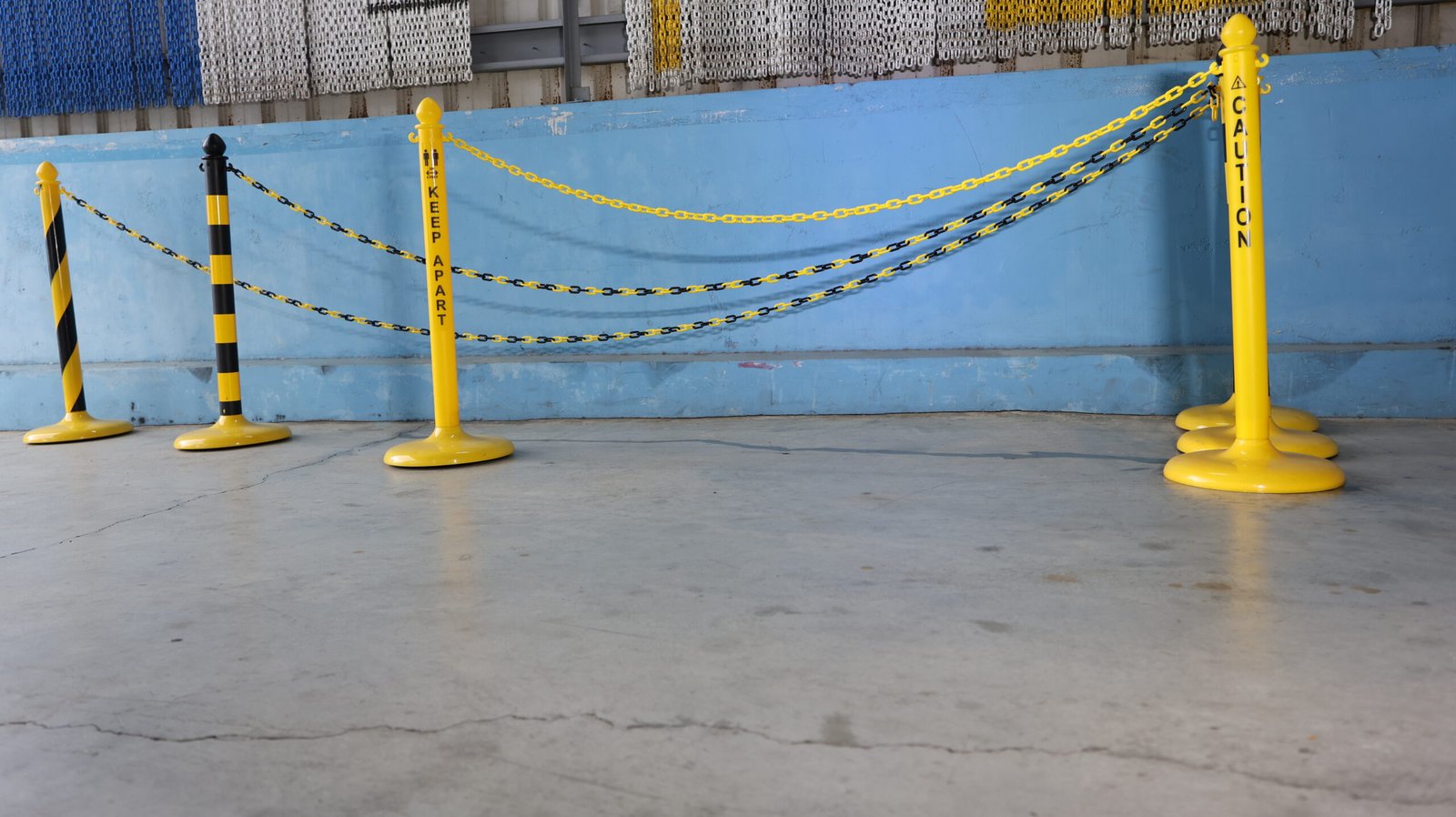
2m vs. 3m vs. 4m: How Much Does the Sag Actually Differ?
Testing plastic stanchions at the recommended spacing produced the following results:
| Chain Length | Recommended Spacing (length − 10cm) | Center Sag Height | Sag Lands At | Best Suited For |
|---|---|---|---|---|
| 4m (400cm) | 390cm | ~30cm | Shin height | Wide-area crowd control, driveways, large venues |
| 3m (300cm) | 290cm | ~35cm | Knee height | Standard queue lines, retail stores, exhibitions |
| 2m (200cm) | 190cm | ~57cm | Thigh height | Narrow walkways, areas needing sharper visual warning |
*Body-height references are based on an adult approximately 175cm (about 5’9″) tall. Actual perceived height will vary by individual stature.
The longer the chain, the greater the sag drop, and the closer that low point falls to the ground — 4-meter chains dip to roughly shin height, 3-meter chains to knee height, and 2-meter chains to thigh height. That means chain length doesn’t just determine spacing; it also determines how visible and how “tall” the barrier reads to pedestrians. Facilities can choose a length based on how prominent they need the barrier line to be.
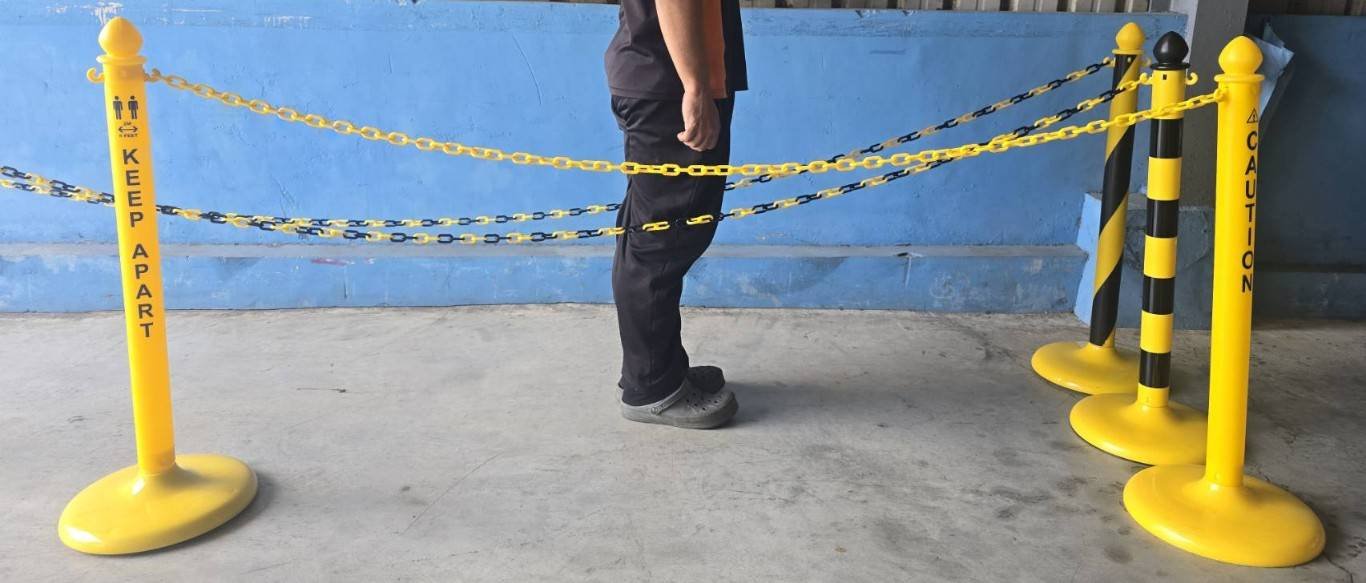
What Happens When the Chain Is Pulled Fully Taut?
One notable finding from testing: when the chain is stretched close to its full length — leaving almost no slack — the difference in center sag height (the natural catenary curve) between 3-meter and 4-meter chains becomes minimal. In other words, sag height is driven more by how much of the chain’s total length is used as spacing, rather than by the chain’s raw length alone. That’s why using a fixed formula — chain length minus 10cm — produces more consistent, predictable results than eyeballing the distance.
A caution here: pulling a chain fully taut makes it more vulnerable to environmental conditions, and this setup is not recommended for outdoor use. A nearly-taut chain is already under higher tension. Add wind, foot traffic bumps, or uneven ground — common outdoor variables — and that tension transfers straight to the stanchion base with little buffer, raising the risk of shifting or tipping. This tighter configuration is better suited to controlled indoor environments. For outdoor installations, sticking to the length-minus-10cm formula, with its natural sag, is the safer approach.
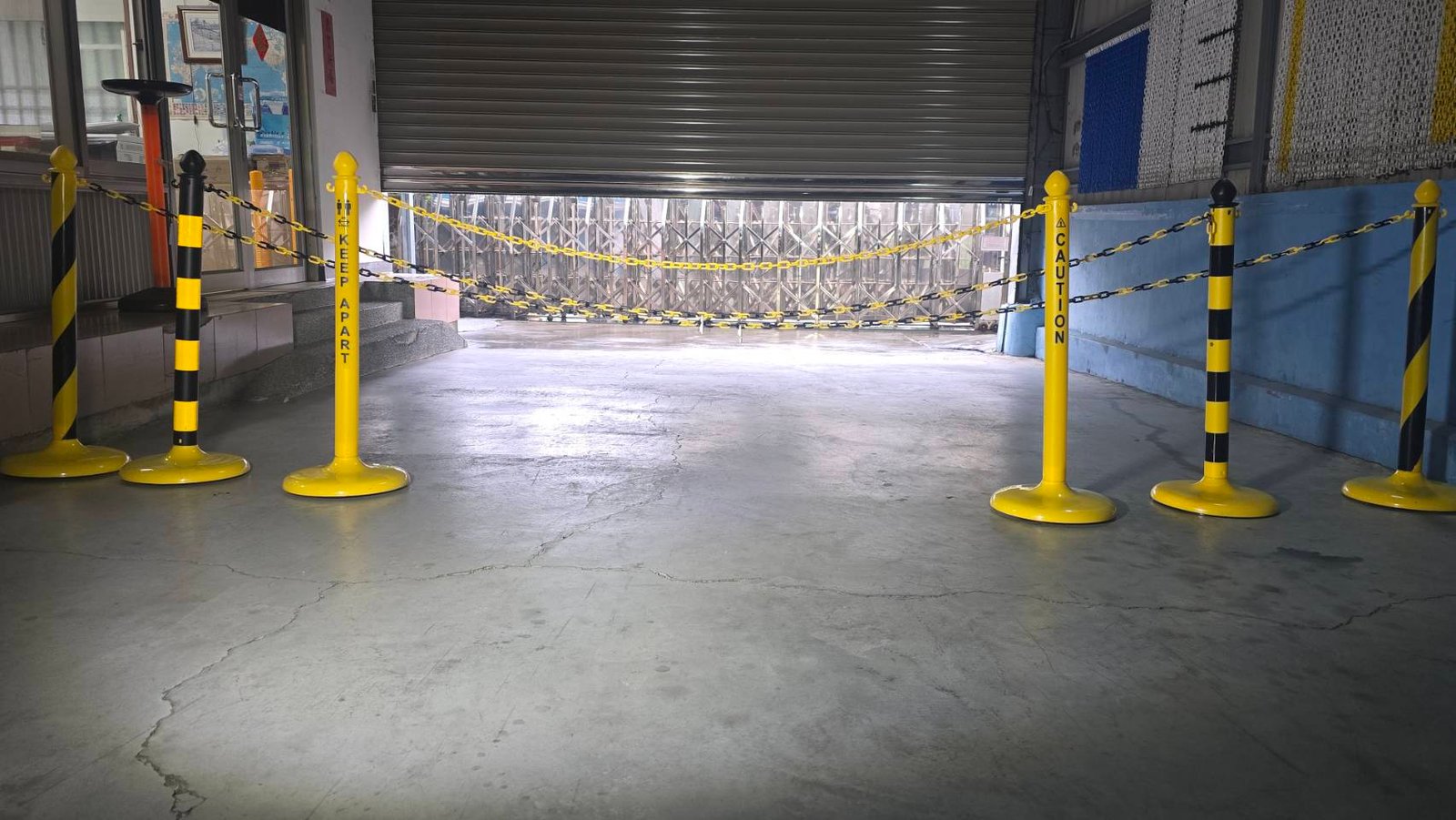
Testing method, briefly:
- Two stanchions were set up and connected using 2m, 3m, and 4m chains
- Spacing was set using the length-minus-10cm formula, and center sag height was measured from the ground
- Sag height was recorded against body-height reference points (shin, knee, thigh) for easy on-site reference
- A separate test measured sag with the chain pulled close to full length, comparing results across chain lengths
Too Much Sag or Too Little — Both Come With Tradeoffs
Sag height isn’t something to maximize or minimize blindly. Getting it wrong in either direction creates real problems:
- Too much sag: A chain hanging too close to the ground is easy to miss, especially in fast-moving foot traffic like mall entrances or event exits — raising the risk of trips and falls.
- Too little sag (overly taut): Tension concentrates at the end hooks and stanchion base. Over time, this can loosen connectors or tilt the stanchion, and a taut chain is more likely to pull a stanchion over entirely if it’s bumped.
- Moderate sag: Following the length-minus-10cm formula lets the chain hang naturally between thigh and shin height, striking a balance — visible enough to serve as a warning, loose enough to keep tension off the base.
Frequently Asked Questions
Q: How long should the chain be between plastic stanchions? A: Set the spacing at chain length minus 10 centimeters. For a 3-meter chain, that’s 290cm of spacing, allowing the chain to sag naturally instead of being pulled straight.
Q: What happens if the chain sags too much? A: Excess sag brings the chain close to the ground, where it’s easy to overlook — increasing trip risk and reducing the barrier’s visual warning effect.
Q: What happens if the chain is pulled too tight? A: Tension concentrates at the hooks and base, which over time can loosen fittings or shift the stanchion. A taut chain is also more likely to pull a stanchion over if bumped.
Q: What chain length works best for a standard queue line? A: Testing points to 3-meter chains — 290cm spacing, roughly 35cm of sag landing at knee height — as the best fit for typical retail and exhibition queue setups.
Q: Does chain length affect stanchion stability? A: Yes. Chain length, spacing, and sag height together determine how tension is distributed. Spacing that’s too wide or a chain pulled too tight both raise the risk of tipping, which is why the length-minus-10cm formula is recommended to preserve a stabilizing amount of sag.
Matching Chain Length to the Space
For wide areas that need to manage large volumes of foot traffic — driveways, large venues — a 4-meter chain with 390cm spacing is a solid fit. For typical retail or exhibition queue lines, a 3-meter chain’s knee-height sag offers the best overall balance. For narrower walkways where a sharper visual warning is needed, a 2-meter chain with 190cm spacing keeps the sag closer to thigh height for a more immediate cue.
PINK BRAND’s plastic stanchions can be paired with any of these chain lengths and spacing configurations. The water-fillable base can be weighted from 4 to 6.8 kg for added stability, and combined with the right chain spacing and sag, delivers a setup that’s both stable and visually clean. For help planning stanchion quantities and chain length for a specific space, our team can walk through the configuration with you.
To browse the full plastic stanchion lineup and chain options, visit pinkbrand.com, or reach out directly to request samples and a quote.