
You may have seen it in a park, on a college campus or outside an office building.
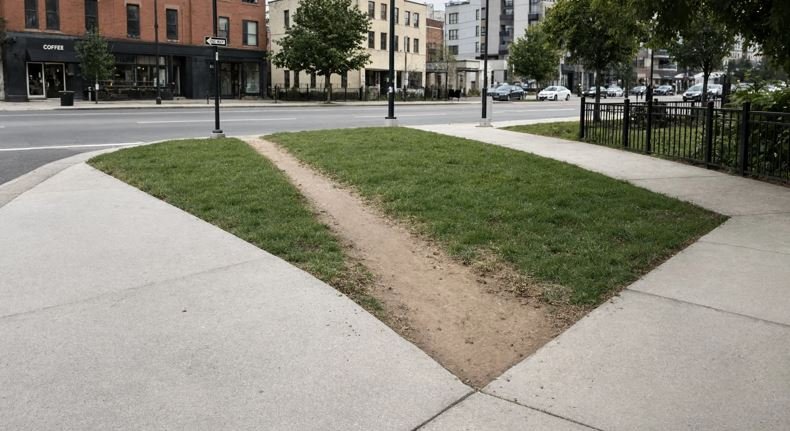
A paved walkway curves around a lawn, but a narrow dirt trail cuts straight across the grass. It may begin with a few footprints. Over time, as more people take the same shortcut, the route becomes impossible to miss.
That unofficial trail is known as a desire path.
Sometimes called a desire line, it is a route created by repeated human movement rather than by planners, architects or property managers.
The idea is simple:
The official path shows where people are expected to walk. A desire path shows where they actually want to go.
Why Do People Create Their Own Routes?
The most obvious reason is distance.
When a destination is directly across a lawn, but the official walkway requires people to move away from it, make several turns and then circle back, many will choose the more direct route.
But distance is not the only factor.
People may take another path because:
- The entrance is difficult to see.
- The exit is poorly marked.
- The official route has too many turns.
- The walkway is narrow or crowded.
- The path is difficult to use with luggage, wheelchairs or strollers.
- The route does not connect directly to the actual destination.
A desire path does not always mean people are deliberately ignoring the rules. It may be a sign that the planned route is inconvenient, unclear or disconnected from the way the space is actually used.
Desire Paths Exist Indoors, Too
Grass and soil make desire paths easy to see, but the same behavior happens inside buildings and other developed spaces.
There may be no dirt trail on the floor, but the pattern is still there.
For example:
- Customers repeatedly walk through the same gap between queue stanchions.
- Travelers step off an escalator and move diagonally toward a service counter.
- Event attendees head directly toward the nearest exit instead of following the original entrance route.
- People with carts, wheelchairs or luggage avoid narrow or sharply turning lanes.
- Employees repeatedly walk around a plastic chain barrier to reach another work area.
One person taking the wrong route may simply have missed a sign.
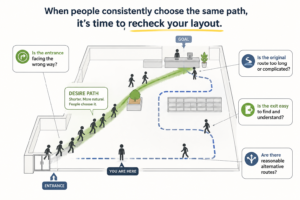
But when many people make the same choice in the same location, it is worth asking a few questions:
- Is the entrance facing the wrong direction?
- Does the official route require unnecessary walking?
- Is the exit easy to identify?
- Is there a practical alternative route?
A Desire Path Is Feedback From the Space
The real value of a desire path is not that it reveals how much people enjoy taking shortcuts.
It shows the difference between how a space was planned and how it is actually being used.
For property managers, event organizers and workplace safety teams, repeated movement patterns can reveal problems involving:
- Entrance placement
- Exit visibility
- Walking distance
- Lane width
- Queue layout
- Traffic flow
- Access to important destinations
A desire path can serve as an informal signal that a layout deserves another look.
Should Every Desire Path Become an Official Route?
No.
Some desire paths lead through areas that should remain restricted, including:
- Forklift and vehicle lanes
- Machinery zones
- Loading docks
- Construction areas
- Uneven surfaces or drop-offs
- Emergency equipment access areas
In these cases, frequent use does not make the route safe.
Instead, the desire path tells managers something important:
People have a real need to move between these locations, but the current safe route may be too difficult to find or too inconvenient to use.
The better response is to understand where people are trying to go and create a safer route that is visible, reasonably direct and separated from serious hazards.
Plastic Stanchion Post and Plastic Chains Help?
Stanchions and plastic chains are often viewed only as barriers.
But because they are portable and easy to reconfigure, they can also be useful tools for testing a new layout before making permanent changes.
For example, managers can:
- Move a queue entrance closer to the direction customers naturally approach from.
- Separate the entrance and exit to reduce opposing traffic.
- Use plastic chains to test a new pedestrian boundary.
- Adjust lane width to accommodate wheelchairs, strollers and luggage.
- Close misleading gaps that look like unofficial entrances.
- Create a clearer route around a restricted or hazardous area.
After making temporary adjustments, managers can observe whether people still cut through the same location or whether they begin using the revised route naturally.
In that sense, stanchions and plastic chains do more than block access.
They allow a space to be tested, observed and improved.
The Goal Is Not to Stop Every Shortcut
Desire paths show how people respond to the spaces around them.
They reveal where official routes feel indirect, unclear or inconvenient. They can also help identify where signs, entrances, exits and physical barriers are not working as intended.
The goal is not to approve every shortcut or remove every restriction.
It is to ask a better question:
Can the safest route also become the clearest and most practical route?
When people can quickly see where to enter, where to exit and how to reach their destination, they are far more likely to follow the intended path.
A desire path shows where people want to go.
Good planning helps them get there safely.
Want to plan better routes with temporary barriers? Read our guide to chain length between plastic stanchions, or contact PINKBRAND for layout advice.