
In a parking lot, the flexible bollards that separate pedestrians from vehicles still look new, but the plastic warning chain strung between them has turned chalky white and snaps in two when you pull it. On a job site, the chain around a material staging area faded after a single summer. You can barely see it from across the yard.
Two chains can look identical when new. The difference usually comes down to one thing you can’t see in the raw material: whether a UV-protection formula was added. That is what separates a UV resistant plastic chain from a standard one.
Short answer: HDPE plastic chain turns chalky and brittle outdoors because UV light breaks apart its molecular chains. A UV resistant plastic chain contains UV stabilizers that slow that aging. They don’t stop it.
Why Does Plastic Chain Turn Brittle in the Sun?
In short: the ultraviolet (UV) light in sunlight slowly makes plastic brittle.
Plastic is made of long molecular chains tangled together. That tangle gives it toughness, so it can stretch and bend. UV light carries enough energy to snap those chains. Combined with oxygen in the air, it sets off a chain reaction called photo-oxidation. The more chains break, the harder and more brittle the plastic gets.
Think of a rope left in the sun for a year: it still looks like a rope, but one hard pull and it falls apart.
Outdoor plastic chain is usually made from HDPE (high-density polyethylene). It’s lightweight, water-resistant and won’t rust, but it isn’t naturally UV resistant. Research also shows that stronger UV and higher temperatures make HDPE lose its ability to stretch faster. So expect aging to show up sooner in places with intense sun and heat.
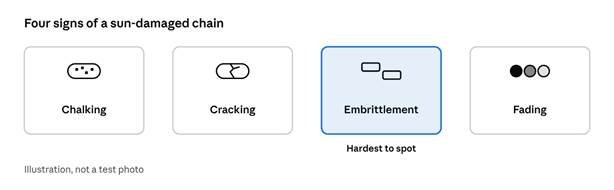
A sun-damaged chain usually shows four signs:
The four signs don’t always appear together. Embrittlement, highlighted above, is the hardest to spot from the outside. By the time you notice, the chain has stopped doing its job and needs early replacement.
How UV Protection Works in Plastic Chain
UV protection works like sunscreen for plastic. The difference is that it’s mixed in at the raw-material stage, so the whole chain is protected from the inside out.
There are three common approaches, and manufacturers usually combine them:
| Approach | Plain analogy | What it does |
| UV absorber | Sunscreen | Absorbs UV first and turns it into harmless heat |
| Light stabilizer (HALS) | Firefighter | Catches the free radicals UV creates and stops the chain reaction. Works better paired with a UV absorber |
| Carbon black, pigments | Umbrella | Blocks UV directly. Carbon black protects best, but only in black products |
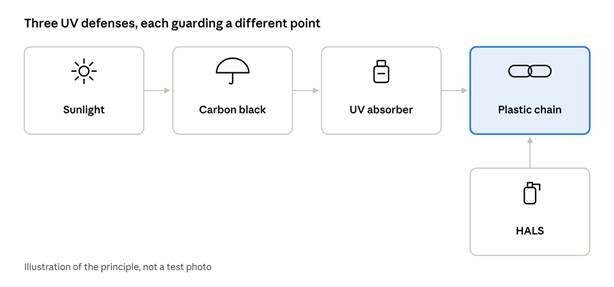
Each defense guards a different point: carbon black and pigments block UV outside, the absorber soaks up what gets through, and HALS cleans up inside the plastic.
At the factory, choosing a formula takes more than a yes or no:
1. Color: Bright warning colors like yellow, red, orange and white can’t rely on carbon black, so the formula needs extra reinforcement. The same formula can perform differently from one color to another.
2. How evenly it’s mixed: Where the additives aren’t evenly spread, parts of the chain go unprotected, and those spots whiten first.
3. Where it will be used: Sun intensity, temperature and expected service life all affect the choice. Raw-material suppliers also match stabilizer packages to climate, color and expected life.
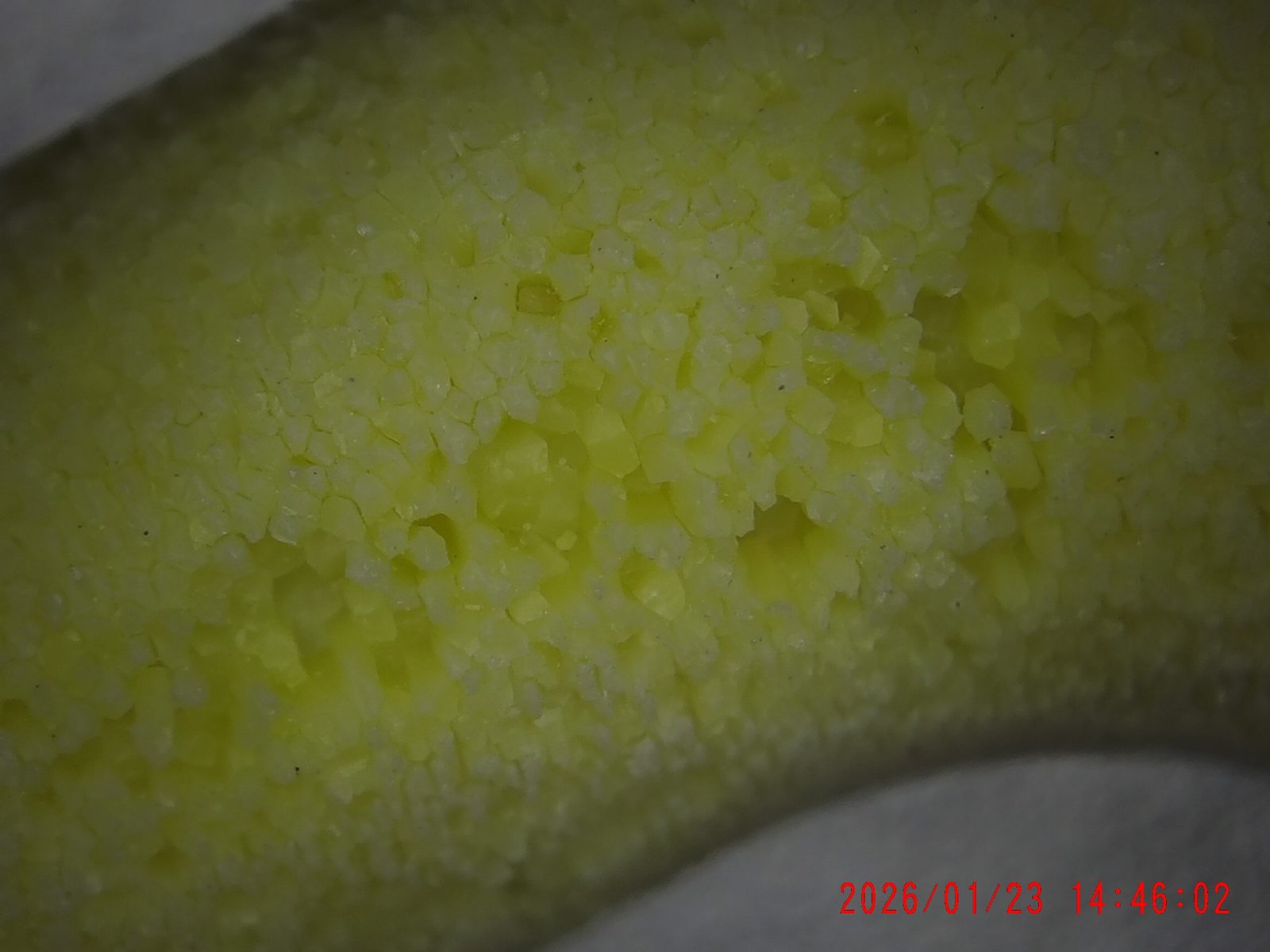
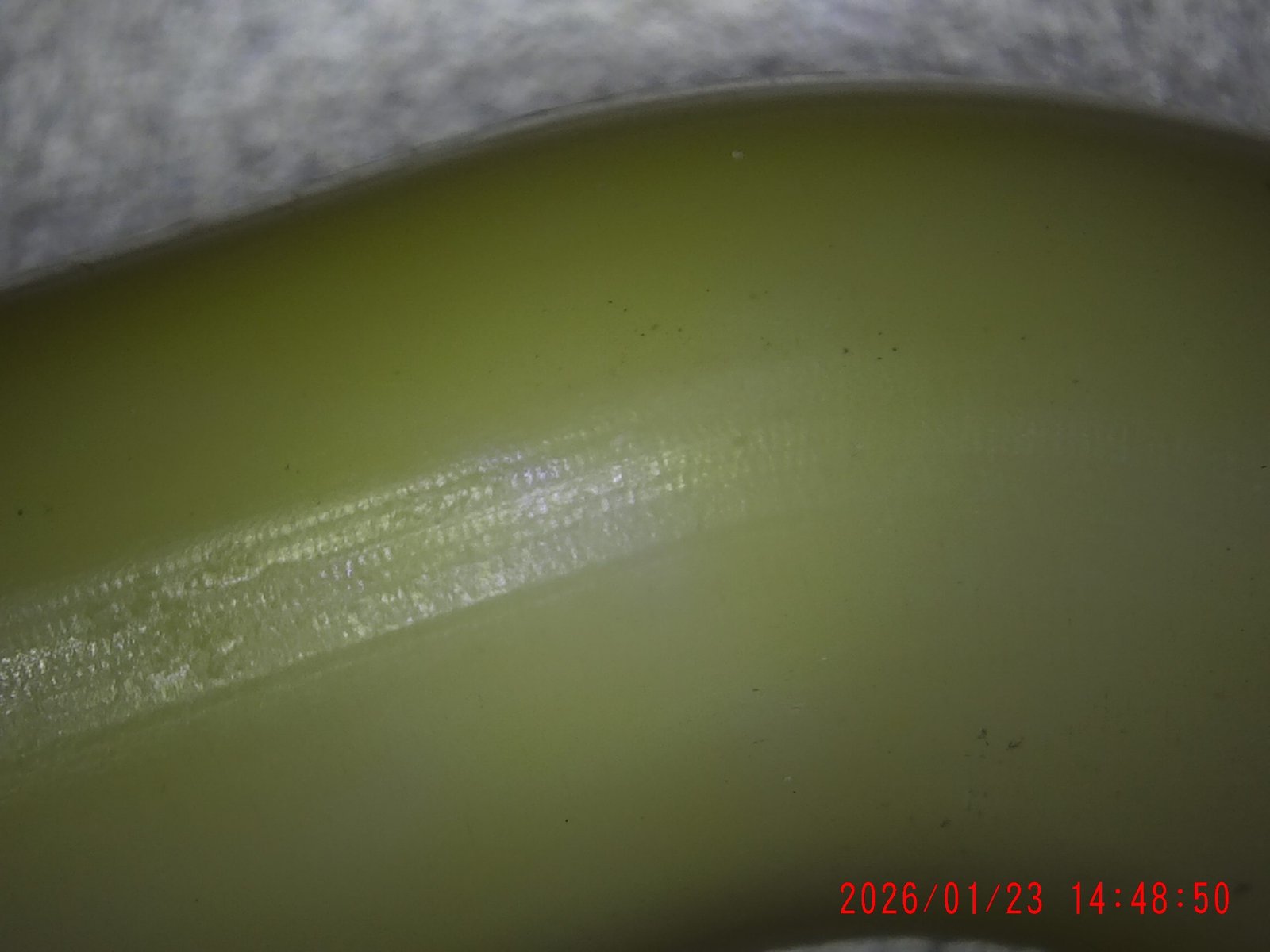
Adding UV protection raises raw-material cost, so not every chain is made with it by default. For short-term use or a tight budget, a standard chain does the job. For long-term outdoor use where appearance matters, we recommend a UV-protected option. Price and weather resistance go hand in hand, so choose the one that fits your situation.
How We Test a UV Resistant Plastic Chain
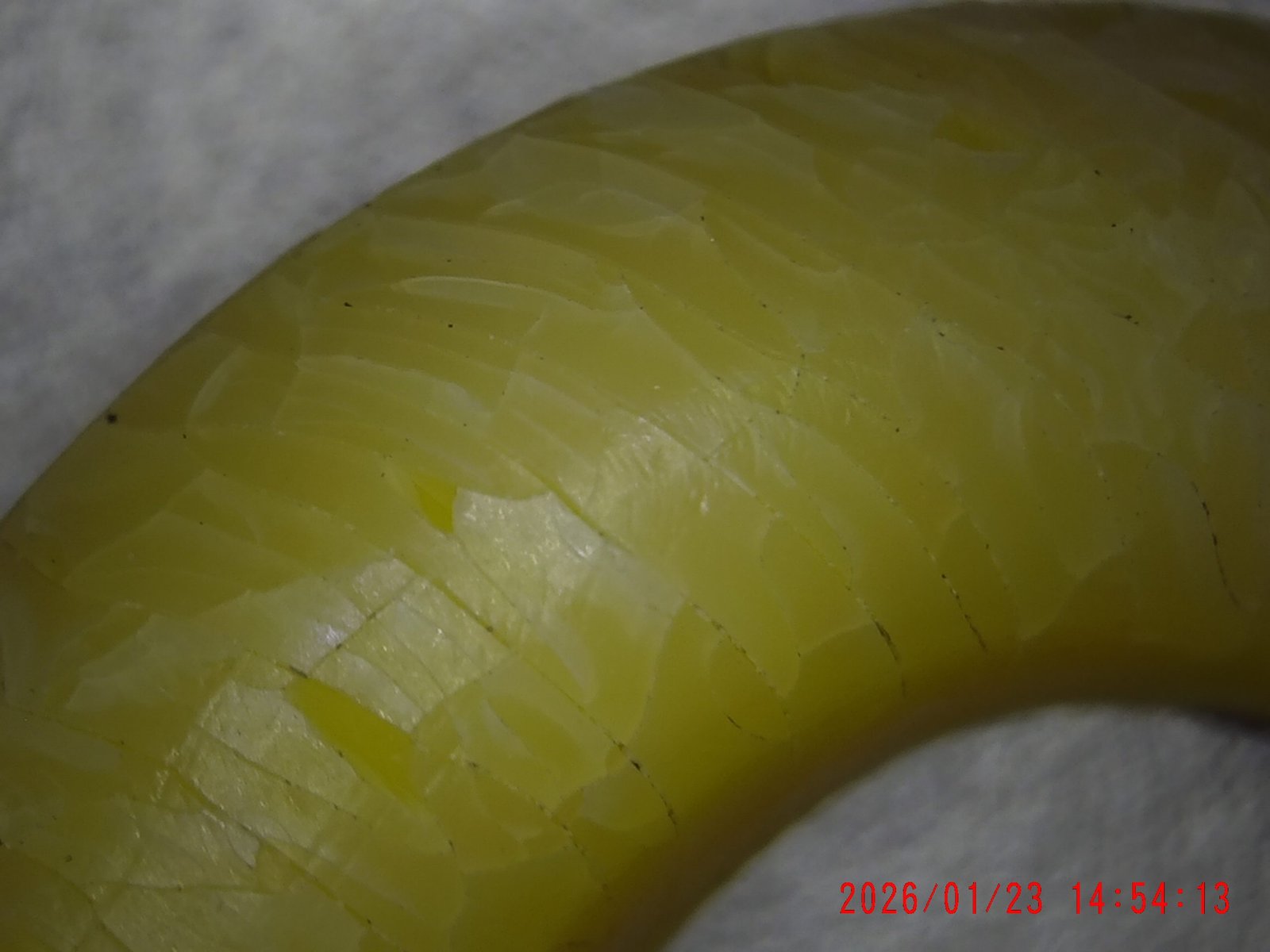
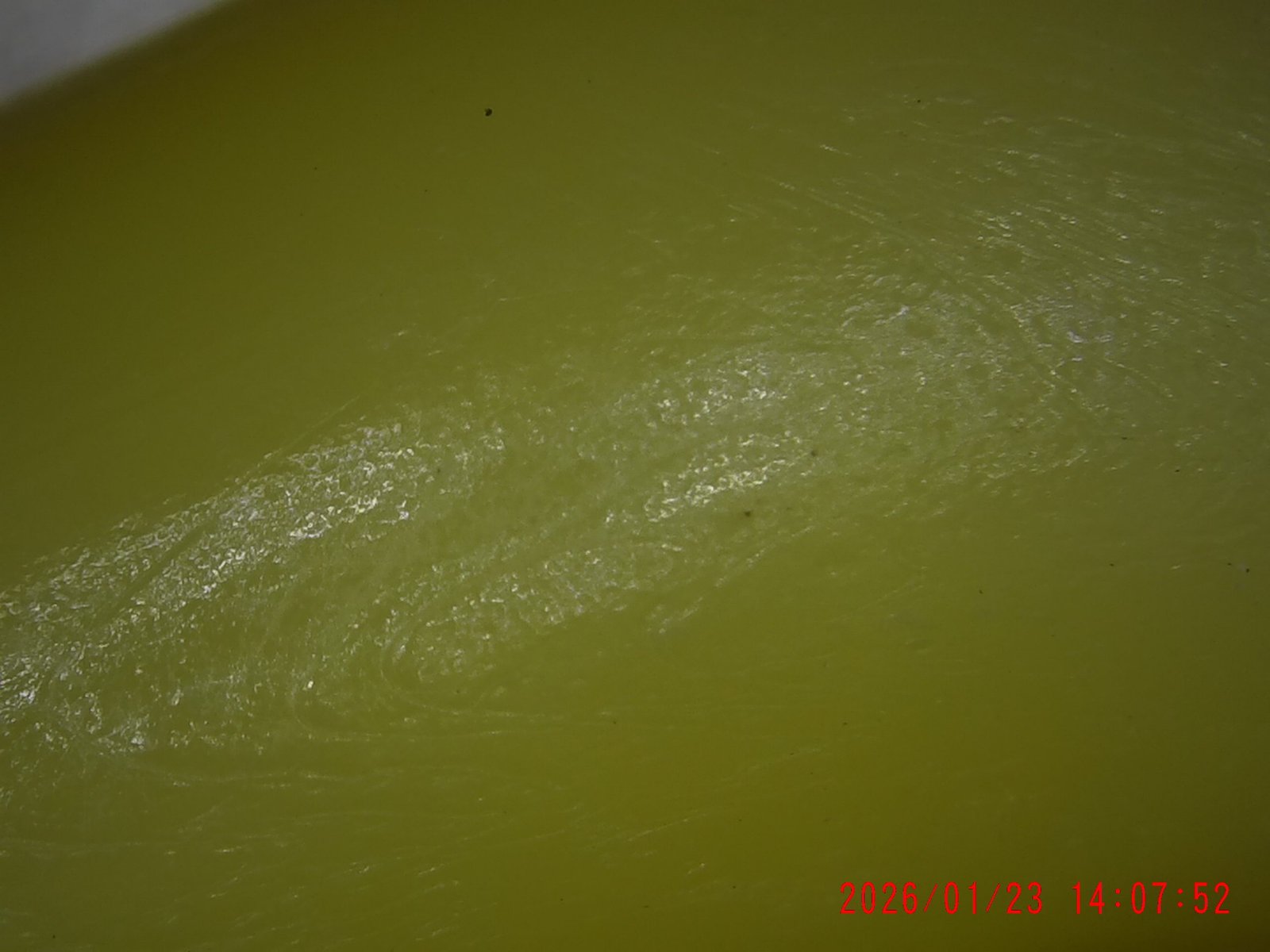
A formula on paper doesn’t prove anything. It has to be exposed. Waiting years for outdoor results takes too long, so we expose chain to a UV lamp continuously, which speeds up aging, and then compare before and after. It’s a simple comparison test, not one run to a specific international standard.
For this test we used a yellow chain sample, the most commonly used color, exposed for up to 1,000 hours. We look at two things:
1. Chalking: Compare the chain at 0 hours and 1,000 hours for visible whitening or haze.
2. Cracking: Inspect the outer side of the links and the bend areas for fine cracks or visible splits.
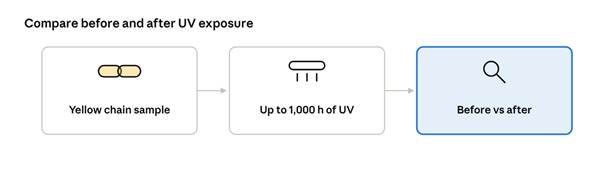
The point is to put before and after side by side, not to rely on adjectives.
Two caveats when you read the results:
- 1,000 hours does not equal a number of years. Laboratory exposure hours can’t be converted into outdoor service life. They’re useful for comparing materials or formulas under the same conditions, which is why we don’t use test hours to promise how long a chain will last.
- No visible change doesn’t mean no change in toughness. Judging strength takes mechanical testing.
Also keep in mind that this was one test on a yellow chain sample. It doesn’t speak for other colors or for every production batch. If your project specifies a color or size, tell us and we can help arrange testing.
How to Choose Outdoor Plastic Chain: 5 Questions for Your Supplier
If the chain will stay in a parking lot, on a job site, around a facility perimeter or at an event for the long haul, ask your supplier these five questions:
1. Formula: Does this model have UV protection? Which type? Is the formula the same across colors?
2. Testing: Has it been through UV exposure or similar weathering tests? What were the conditions, and how long did it run?
3. Evidence: Can you see before-and-after photos or data, not just the words “UV protected”?
4. Specs: Do the color, link size and package length fit your site’s warning needs?
5. Pairing: If you’re using it with flexible bollards or posts, will the chain’s weather resistance keep up? Otherwise the posts are fine and the chain is the first thing you replace.
For short-term use, you don’t need the highest weather-resistance grade. Spend the extra only when the chain will be outdoors for the long haul. Also remember that plastic chain is for visual warning, zone separation and traffic guidance. It’s not a substitute for a physical barrier built to take an impact.
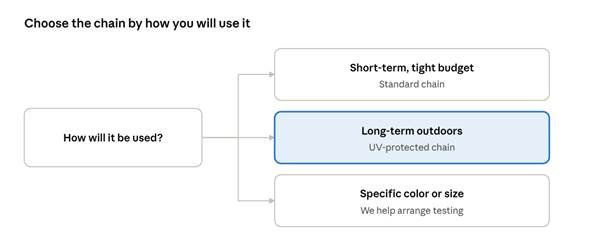
Not every job needs the top grade. Matching the chain to the situation keeps you from overspending.
Where Plastic Chain Is Used: Parking Lots, Job Sites and Events
Plastic chain is a visual barrier, not a physical one. It shows up in three common places:
- Parking lots and garages: separating pedestrian walkways from vehicle lanes, often strung between flexible bollards or posts.
- Construction and job sites: marking material storage areas and restricted zones.
- Events and public venues: guiding crowds and forming queues.
Outdoors, all three put the chain in direct sun, which is why UV protection matters.
UV Resistant Plastic Chain FAQ
Why does plastic chain turn chalky?
UV light triggers photo-oxidation. The surface develops fine cracks and roughness that scatter light, so it looks hazy.
Does UV protection mean a chain won’t fail?
No. It slows the aging but doesn’t stop it.
How many outdoor years is a 1,000-hour test?
You can’t convert it. Lab conditions are fixed, while outdoor sun, temperature and rain change every day. The test is for comparing materials.
Do short events need a UV resistant chain?
For a few days to a few weeks, it makes little difference. But if you reuse the chain after the event, the sun exposure adds up and ages it.
About PINKBRAND
PINKBRAND has made plastic chain in Chiayi, Taiwan since 1979 and ships to Japan, the United States and Europe. Every customer’s budget and site are different, so we offer more than one tier of plastic chain.
How we approach quality:
- Options by need: A standard chain for tight budgets or short-term use. For long-term outdoor use where appearance matters, we recommend a UV-protected option. You get what you pay for, and we’ll explain the difference plainly.
- Proof, not promises: We exposed a yellow chain sample to a UV lamp for up to 1,000 hours and kept the before-and-after photos.
- Testing on request: If your project calls for a specific color or size, tell us and we’ll help arrange testing.
- No big claims: Every site is different, so we don’t use test hours to promise a service life.
Need outdoor plastic chain for separating pedestrians and vehicles in a parking lot, marking material zones on a job site, or routing event foot traffic? Contact PINKBRAND. Tell us about your site and budget, and we’ll recommend an option, send samples or arrange testing.
mail: sales@pinkbrand.com