
That “Crunch” is the Sound of a Breaking Heart
For professional drivers who spend their days on the road, safety is the only true path home. However, in the rush of unloading cargo or signing invoices, it is easy to develop “mental blind spots.”
Have you ever experienced this? You followed the rules and placed your wheel chocks, but when you returned to the cab and started the engine, you forgot to remove them. The result? The tires rolled right over the chocks, damaging equipment and causing the vehicle to lurch dangerously. This isn’t a lack of skill; it’s a natural human error during a busy shift. Today, we’re sharing a simple “Error-Proofing” (Poka-yoke) mechanism to ensure transportation safety never has another loophole.
Why You Can’t Just “Wedge Anything” Under the Tire
According to current Occupational Safety and Health regulations, trucks must use wheel chocks when stationary to prevent accidental rolling. This isn’t just to pass inspections; it serves as the final physical line of defense on inclines or during mechanical failures (such as a handbrake failure).
The industry currently recommends yellow PVC wheel chocks. Compared to heavy traditional wood, PVC is lightweight and highly visible. However, even the best materials are useless if placed incorrectly.
The Correct Placement SOP:
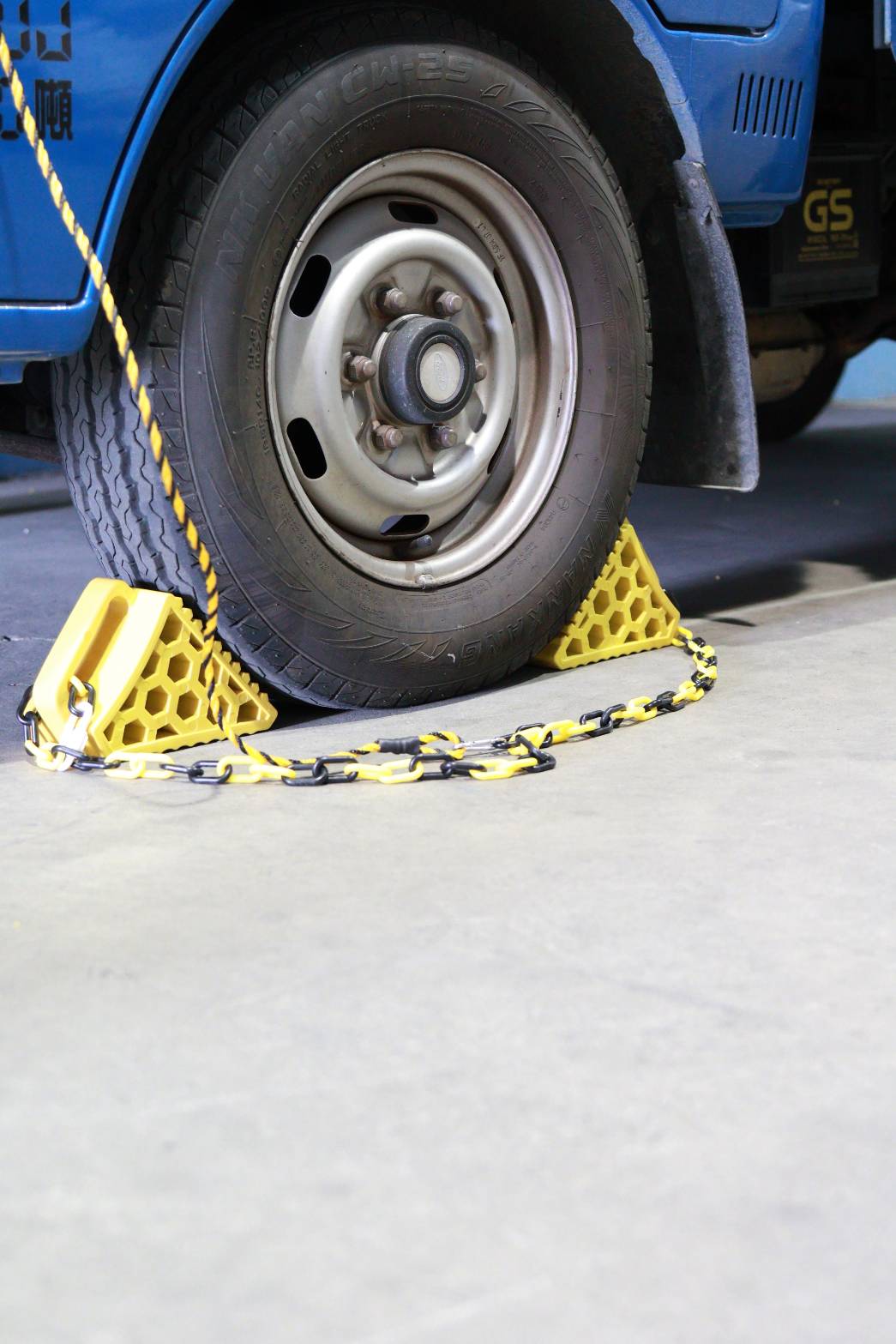
- The Sandwich Method: Chocks must be placed snugly against the front and back of the same tire to ensure the vehicle is locked in both directions.
- Chain Connection: It is recommended to link two chocks with a chain. This ensures even tension and prevents one from being left behind during pack-up.
Key Technique: The High-Efficiency “Rearview Mirror Tag” System
In the transport industry, details determine success. The most effective way to avoid “forgetting the chocks” isn’t relying on memory—it’s establishing a physical linkage system.
How to Operate This Error-Proofing System:
The core of this system is linking the obstacle on the ground to the driver’s line of sight:
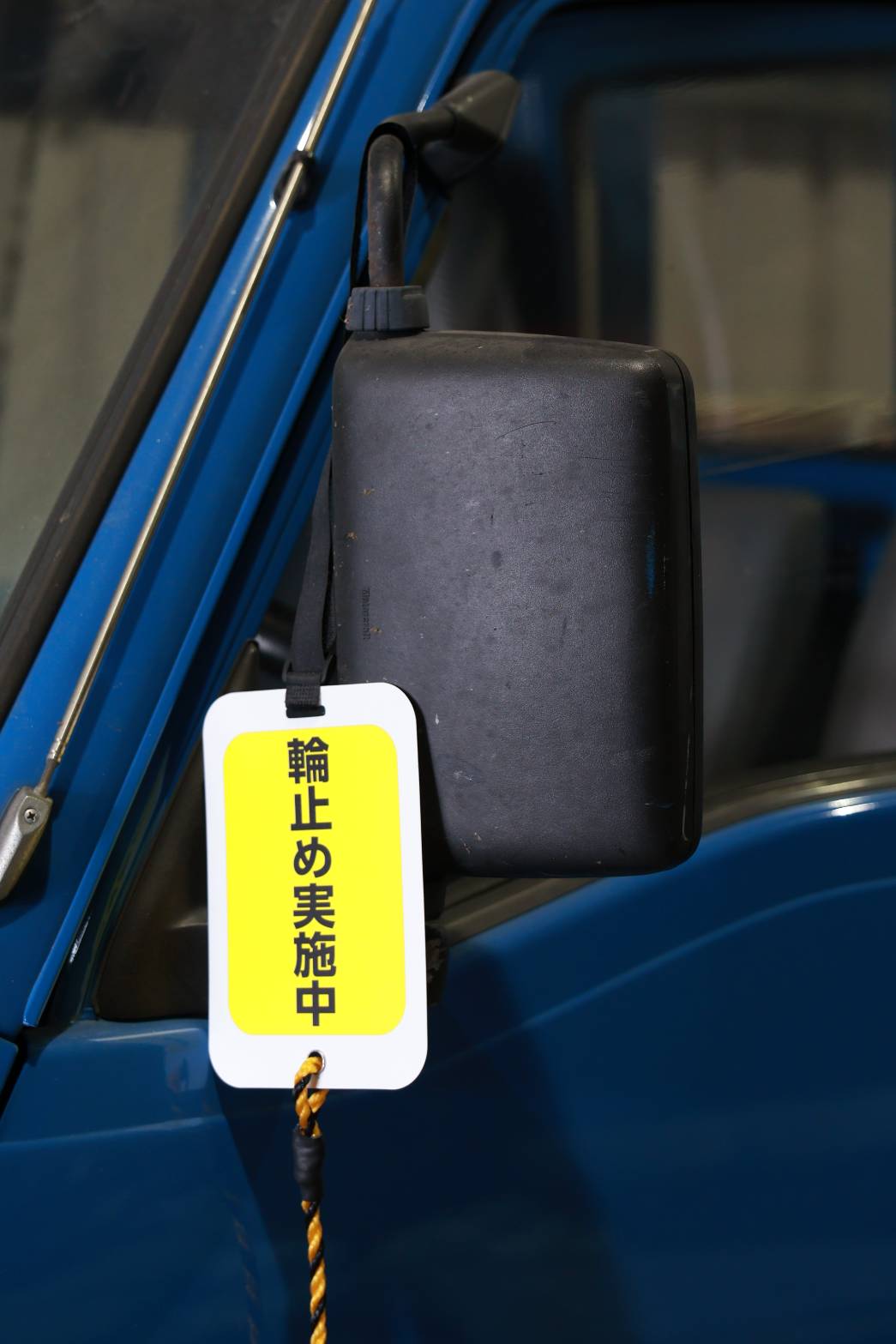
- Step 1: Link the Hook: Use a durable snap hook to attach the reminder tag’s cord to the wheel chock chain.
- Step 2: Lock the Side Mirror (Bakuniyā): Hang the other end of the tag over the driver-side mirror.
When the tag is hanging on the mirror (often called Bakuniyā in industry slang), the driver is guaranteed to see it before entering the cab. It serves as a forced reminder: “There is still something on the ground.” This is the most scientific approach to safety—intercepting the line of sight instead of relying on memory.
Objective Comparison: PVC vs. Other Materials
Choosing the right equipment can significantly improve operational efficiency:
| Material | Pros | Cons |
| PVC (Recommended) | High visibility (Bright Yellow), weather-resistant, moderate weight. | Slightly higher cost than wood. |
| Rubber | Excellent grip; the first choice for heavy-duty vehicles. | Heavy; physically demanding for long-term handling. |
| Wood | Lowest acquisition cost. | Prone to rot, cracking, and molding after rain. |
Frequently Asked Questions (FAQ)
Q1: Is it okay to chock only one side of the tire?
A: Not recommended. When a vehicle is loaded with heavy goods, the center of gravity can shift. The “sandwich” (clamping) method ensures the vehicle remains rock-solid even during minor vibrations.
Q2: Is a reminder tag really necessary?
A: Statistics show many transport accidents occur at the “moment of start-up.” The tag prevents the driver from crushing the chocks, stalling the engine, or experiencing an accidental surge.
Q3: What other accessories should I choose?
A: Wheel chocks can be paired with plastic chains, making them easier to carry and ensuring the pair stays together.
Safety is for the Long Haul
Safety regulations are not tedious restrictions; they are the armor that protects your professional career. By using the dual mechanism of wheel chocks and reminder tags, we can minimize human error. To all the “Senior Drivers” out there: next time you park, don’t forget to hang that tag on the mirror. Give yourself that extra layer of protection!
Has your fleet implemented this safety mechanism? Or do you have your own “error-proofing” tips? Share your thoughts in the comments below or share this article with your colleagues to help improve the transportation safety environment!
We offer the plastic chains and accessories mentioned in this article. Please feel free to inquire!
mail: sales@pinkbrand.com