
As global temperatures continue to rise, Taiwan’s summers are becoming increasingly dangerous. From May through October, high humidity and intense sunlight create severe heat stress conditions that can quickly lead to heat exhaustion or even life-threatening heat stroke.
Many people check the weather and see temperatures around 32°C or 35°C. However, the actual temperature felt by the human body can be significantly higher due to humidity, solar radiation, and poor airflow.
This is why understanding the Heat Index and WBGT (Wet Bulb Globe Temperature) is becoming more important for outdoor workers, athletes, employers, schools, factories, and the general public.
In this guide, you will learn:
- What Heat Index means
- How heat stress is calculated
- The difference between Heat Index and WBGT
- Taiwan’s official WBGT workplace standards
- Heat stroke symptoms and emergency response
- Practical heat safety and prevention tips
Source reference adapted from uploaded document
Why Understanding Heat Index Matters
Air temperature alone does not accurately represent how dangerous hot weather can become.
For example:
- Air temperature: 32°C
- High humidity: 80%
- Direct sunlight exposure
Under these conditions, the human body may experience heat stress equivalent to 40°C or more.
Several environmental factors contribute to this effect:
Relative Humidity
Humidity reduces the body’s ability to cool itself through sweat evaporation.
When humidity is high:
- Sweat evaporates more slowly
- Body heat remains trapped
- Core temperature rises faster
This is why humid heat is often more dangerous than dry heat.
Solar Radiation
Direct sunlight dramatically increases surface and skin temperature.
In Taiwan’s summer climate, pavement, metal surfaces, vehicles, and rooftops can become dangerously hot even when air temperature appears manageable.
Wind Speed and Airflow
Air movement helps sweat evaporate more efficiently.
Poor ventilation or stagnant air can significantly increase heat stress risk.
What Is Heat Index?
The Heat Index is a measurement that combines air temperature and relative humidity to estimate how hot the environment actually feels to the human body.
It is commonly referred to as the:
- “Feels-like temperature”
- Apparent temperature
- Perceived temperature
Heat Index is especially useful because it reflects the body’s actual heat burden rather than air temperature alone.
How the Human Body Regulates Heat
The human body cools itself mainly through sweat evaporation.
Under normal conditions:
- Sweat forms on the skin
- Sweat evaporates
- Heat leaves the body
However, in humid environments:
- The air already contains high moisture levels
- Sweat cannot evaporate effectively
- Internal body heat accumulates rapidly
When core body temperature exceeds 40°C (104°F), the risk of heat stroke becomes extremely serious.
Simple Heat Index Formula
One commonly used simplified educational formula is:
Feels-Like Temperature=T+5(RH−40)
Where:
- T = Air temperature (°C)
- RH = Relative humidity (%)
Example Heat Index Calculation
Environment:
- Temperature: 32°C
- Relative Humidity: 80%
Calculation:
32+5(80−40)=40∘C
Result:
- Feels-like temperature ≈ 40°C
This demonstrates how humidity dramatically increases heat stress.
Advantages of the Simplified Formula
Easy to Understand
Only two measurements are required:
- Air temperature
- Relative humidity
Fast Daily Evaluation
Useful for:
- Outdoor activities
- Personal safety awareness
- Public education
- Quick heat risk estimation
Limitations of Basic Heat Index Formulas
Although useful, simplified formulas have limitations.
They do not account for:
- Solar radiation
- Surface heat reflection
- Wind speed
- Environmental heat accumulation
As a result, professional safety assessments require a more advanced system: WBGT.
What Is WBGT?
WBGT stands for:
Wet Bulb Globe Temperature
WBGT is an internationally recognized heat stress measurement standard used for:
- Occupational safety
- Military training
- Sports events
- Construction work
- Factory environments
- Outdoor labor protection
Taiwan’s Ministry of Labor officially adopts WBGT for workplace heat hazard management.
Organizations using WBGT include:
- International Labour Organization (ILO)
- ISO occupational safety standards
- Japanese Ministry of Environment
- OSHA-related occupational heat programs
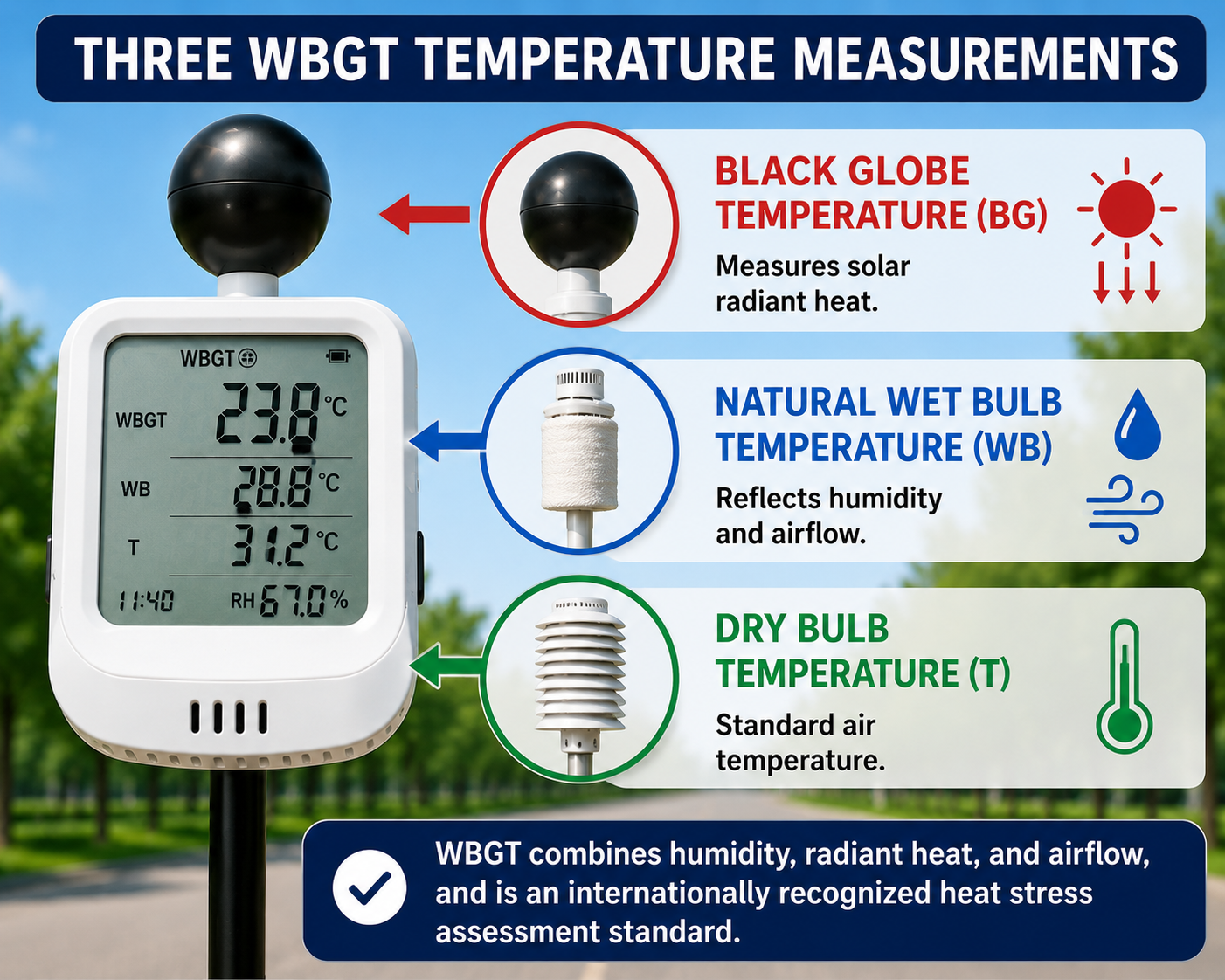
WBGT Measures Three Critical Factors
1. Wet Bulb Temperature (WB)
Measures:
- Humidity
- Evaporative cooling efficiency
- Airflow effects
2. Black Globe Temperature (BG)
Measures:
- Solar radiation
- Radiant heat exposure
- Heat absorbed from surroundings
This is especially important under direct sunlight.
3. Dry Bulb Temperature (T)
Measures:
- Standard ambient air temperature
This is the normal temperature reported in weather forecasts.
Official WBGT Formula
For outdoor environments with sunlight exposure:
WBGT=0.7WB+0.2BG+0.1T
For indoor or shaded environments:
WBGT=0.7WB+0.3BG
WBGT Calculation Example
Typical Taiwan summer conditions:
- Wet Bulb Temperature = 31°C
- Black Globe Temperature = 62°C
- Dry Bulb Temperature = 35°C
Calculation:
0.7(31)+0.2(62)+0.1(35)=37.6∘C
Result:
- WBGT = 37.6°C
This represents extremely dangerous heat stress conditions.
Why WBGT Is More Accurate Than Heat Index
Basic Heat Index formulas estimate humidity effects mathematically.
WBGT directly measures:
- Radiant heat
- Environmental heat load
- Airflow conditions
This makes WBGT far more accurate for real-world occupational safety situations.
In Taiwan’s subtropical climate, intense sunlight can dramatically increase black globe temperature, making outdoor environments much more dangerous than air temperature alone suggests.
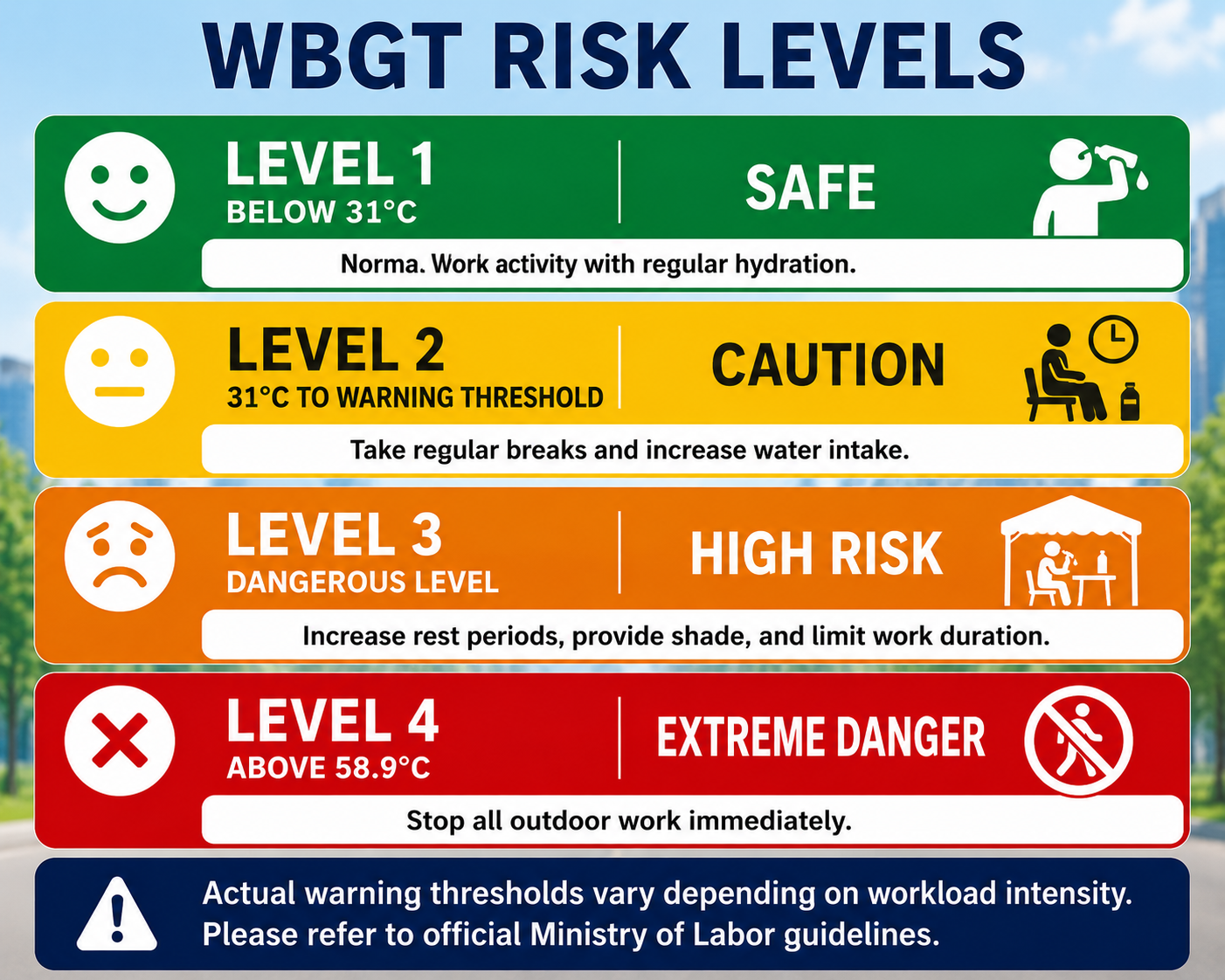
Taiwan’s Official WBGT Risk Levels
According to Taiwan occupational heat safety guidelines:
| WBGT Level | Risk Level | Recommended Action |
|---|---|---|
| ≤ 31°C | Low Risk | Normal activity with hydration |
| 31–32°C | Moderate Risk | Increase rest breaks |
| 32–41°C | High Risk | Reduce workload and provide shade |
| > 41°C | Extreme Danger | Stop outdoor work immediately |
Actual limits vary depending on:
- Work intensity
- Exposure duration
- Physical condition
- Protective clothing requirements
What Is Heat Stroke?
Heat stroke is a life-threatening medical emergency caused by severe overheating of the body.
Medical criteria include:
- Core body temperature above 40°C
- Central nervous system dysfunction
- Possible organ failure
Without immediate treatment, heat stroke can become fatal.
Common Heat Stroke Symptoms
Early Warning Signs
- Dizziness
- Headache
- Nausea
- Muscle cramps
- Excessive fatigue
- Rapid heartbeat
Severe Symptoms
- Confusion
- Loss of coordination
- Aggressive or unusual behavior
- Collapse
- Loss of consciousness
- Hot, dry skin without sweating
Loss of sweating is an extremely dangerous warning sign.
High-Risk Groups
People at higher risk include:
- Outdoor workers
- Elderly individuals
- Young children
- Athletes
- Military personnel
- People with cardiovascular disease
- Individuals taking antihistamines or blood pressure medication
Heat Risk Assessment Zones
| Heat Stress Level | Risk |
|---|---|
| Below 28°C | Safe |
| 28–32°C | Caution |
| 32–41°C | Dangerous |
| Above 41°C | Extreme Danger |
At extreme heat levels, outdoor activities should be minimized immediately.
Emergency Response for Heat Stroke
If heat stroke is suspected:
Step 1: Move the Person to a Cooler Area
- Stop all activity immediately
- Move indoors or into shade
- Remove unnecessary clothing
Step 2: Begin Rapid Cooling
- Apply cold wet towels
- Use fans or air conditioning
- Place ice packs on the neck, armpits, and groin
Step 3: Call Emergency Services
Seek emergency medical assistance immediately.
Continue cooling efforts while waiting for help.
Important Heat Stroke Warning
Do NOT:
- Wait for symptoms to improve naturally
- Force large amounts of ice water quickly
- Ignore confusion or altered behavior
Every minute matters during severe heat stroke.
Daily Heat Prevention Tips
Stay Hydrated
- Drink water regularly
- Do not wait until thirsty
- Increase water intake during outdoor work
Wear Appropriate Clothing
- Light-colored clothing
- Breathable fabrics
- Wide-brim hats
- UV protection
Avoid Peak Heat Hours
Limit outdoor activity between:
- 10:00 AM and 3:00 PM
Gradually Adapt to Heat
The body typically needs:
- 2–4 weeks to acclimate to hot environments
Workplace Heat Safety Recommendations
Employers should:
- Monitor WBGT regularly
- Provide shaded rest areas
- Ensure easy access to drinking water
- Rotate workers during peak heat periods
- Train employees to recognize heat illness symptoms
- Establish emergency heat response procedures
Frequently Asked Questions
Why Does Taiwan Use WBGT Instead of Standard Heat Index?
Because WBGT includes:
- Humidity
- Solar radiation
- Airflow
- Environmental heat load
This makes it much more accurate for occupational safety.
Can I Measure WBGT Myself?
Professional WBGT meters are recommended because accurate measurement requires specialized instruments and proper calibration.
Does a Heat Index Above 41°C Mean Immediate Heat Stroke?
Not necessarily.
Heat Index reflects environmental heat stress, not actual core body temperature.
However, prolonged exposure under these conditions can quickly become dangerous.
Final Thoughts
Taiwan’s summer climate is not just uncomfortable — it can become medically dangerous within a very short time.
The two most important things to remember are:
1. Humidity and sunlight can be just as dangerous as air temperature
2. Early symptoms should never be ignored
Understanding Heat Index and WBGT standards can help prevent avoidable heat-related illness, hospitalization, and death.
Whether you are working outdoors, exercising, traveling, or managing workplace safety, heat awareness is becoming increasingly essential in Taiwan’s climate.
Recommended Meta Description
Learn how Taiwan calculates heat stress using Heat Index and WBGT standards. Understand heat stroke symptoms, WBGT formulas, workplace safety guidelines, and summer heat prevention tips.
mail: sales@pinkbrand.com