
From Psychological Guidance to Secure Barriers: The Art of Plastic Bollards
In department stores, exhibitions, or any public venue, the “queue” is often the first touchpoint of the customer experience. Chaotic lines lead to frustration, while a fluid flow minimizes friction. How can you use bollards and chains to create a management solution that balances aesthetics with efficiency? This guide provides an in-depth analysis.
I. The Psychology of Queuing: Why Your Layout Needs Bollards
The core of flow planning lies in “nudging” rather than forcing. Unlike traffic cones—which signal danger and are easily bypassed—bollards play a more sophisticated role in crowd management:
- Instilling Self-Discipline: At approximately 100 cm tall, bollards sit right at hip level for most adults. This visual height creates a powerful psychological barrier, signaling a “designated zone” and effectively reducing the urge to cut in line.
- Reducing Wait Anxiety: S-shaped or U-shaped paths defined by chains give participants a sense of continuous “flow.” Clear guidance from start to finish is the secret to increasing perceived efficiency.
- Visual Continuity: The catenary curve formed by hanging chains provides a more substantial physical presence than retractable belts. Over long distances, chains offer an uninterrupted visual boundary that prevents people from ducking through the lines.
II. Plastic Bollards: A Versatile Solution
To meet the dual demands of modern space management—mobility and durability—plastic chain bollards have become the industry standard for balanced performance.
1. Maximum Deployment Efficiency
- Ultra-Lightweight: Weighing only 1.2 kg when empty, a single person can transport large quantities easily. This is a massive operational advantage for PR firms handling pop-up events or short-term exhibitions.
- Tool-Free Modularity: Featuring a 100% screw-less assembly, parts can be replaced individually if damaged. Their compact storage footprint significantly reduces warehousing and logistics costs.
2. Customizable Weight Distribution
- Stable Protection: Once the base is filled with water, the weight increases to 4 kg. This allows the bollards to withstand heavy crowds, outdoor winds, and the air turbulence from passing vehicles, ensuring your boundaries remain steadfast.
3. Weather Resistance and Safety Signaling
- Reinforced HDPE: Made from High-Density Polyethylene, these units are highly UV-resistant and waterproof. Whether in a climate-controlled gallery or under the scorching sun and rain, they resist fading and brittleness.
- Enhanced Visibility: Integrated reflective strips provide safety in low-light environments. With 9 color options available, you can perfectly align “brand aesthetics” with “safety regulations.”
III. Practical Application Scenarios
Scenario A: Brand Events & Exhibitions — Creating Elegance
In luxury boutiques or pop-up stores, using sleek black or white bollards with elegant chains does more than manage a line—it establishes brand prestige. The graceful curve of the chain softens architectural lines, turning the wait into a curated experience.
Scenario B: Outdoor Engineering & Traffic Control — A Solid Defense
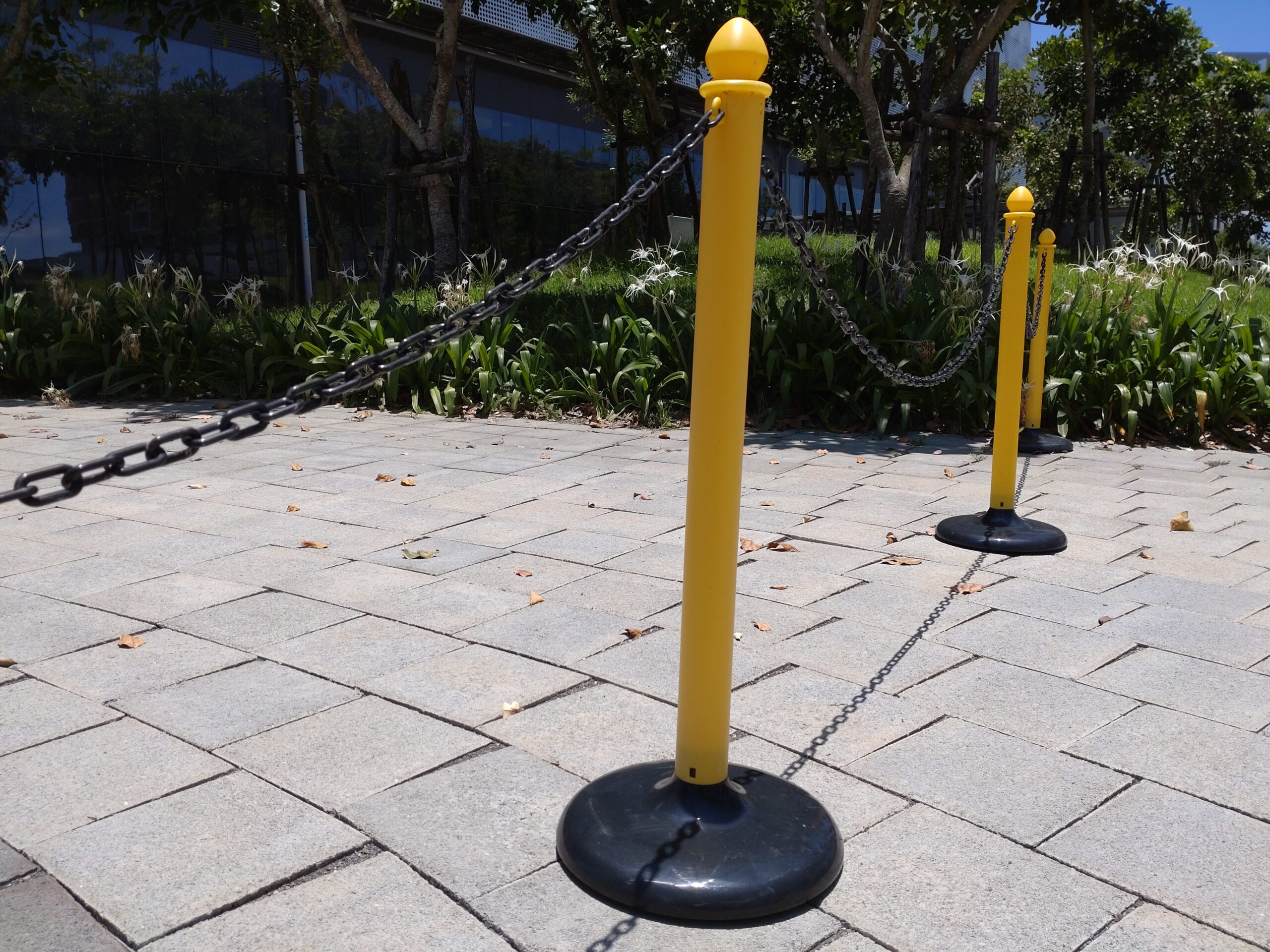
For roadside maintenance or parking lots, opt for high-contrast yellow/black or red/white schemes. Combined with high-visibility reflective tape and weighted bases, these bollards effectively segregate pedestrians from vehicles, ensuring safety is never compromised.
IV. Specifications at a Glance: Optimizing Your Management
| Feature | Description | Queue Management Advantage |
| Material | Reinforced HDPE (High-Density Polyethylene) | Weatherproof and impact-resistant for any environment. |
| Weight | 1.2 kg (Empty) / 4 kg (Water-filled) | Adjustable for easy transport or high wind stability. |
| Assembly | 100% Screw-less Modular Design | Low maintenance costs; adaptable to various scale needs. |
| Visibility | 9 Color Options + Reflective Strips | Meets both branding and traffic safety standards. |
| System | Dedicated S-Hooks & Plastic Chains | Stronger physical barrier; lower cost for long-distance flow. |
V. Queue Planning FAQ
- Q: How many bollards do I need for my layout?
- A: We recommend placing a bollard every 1.5 to 2 meters. For routes with many turns, shorten the interval to maintain chain tension and visual clarity.
- Q: Are plastic chains really better than retractable belts?
- A: For outdoor or high-frequency use, yes. Retractable mechanisms often fail due to sand, grit, or moisture. Plastic chains are simple, washable, UV-resistant, and have much lower long-term maintenance costs.
- Q: Does the base leak after being filled with water?
- A: Our HDPE bases use one-piece molding technology paired with high-sealing plugs, ensuring they remain leak-proof even during frequent relocation.
Conclusion
Bollards are the silent language of space managers. A set of HDPE plastic chain bollards is a tool for efficiency when light, and a foundation for safety when weighted. They don’t just solve the chaos of a queue—they elevate the operational flow of your entire venue.
Ready to design the optimal flow for your space? Let us help you solve complex crowd issues with the simplest, most effective tools!
Email: sales@pinkbrand.com
Phone: +886-5-221-7137
Would you like me to adjust the tone to be even more formal, or perhaps create a version specifically tailored for a LinkedIn post or a brochure?